When you sit down at an izakaya in Japan, a small dish may arrive before you even choose any food.
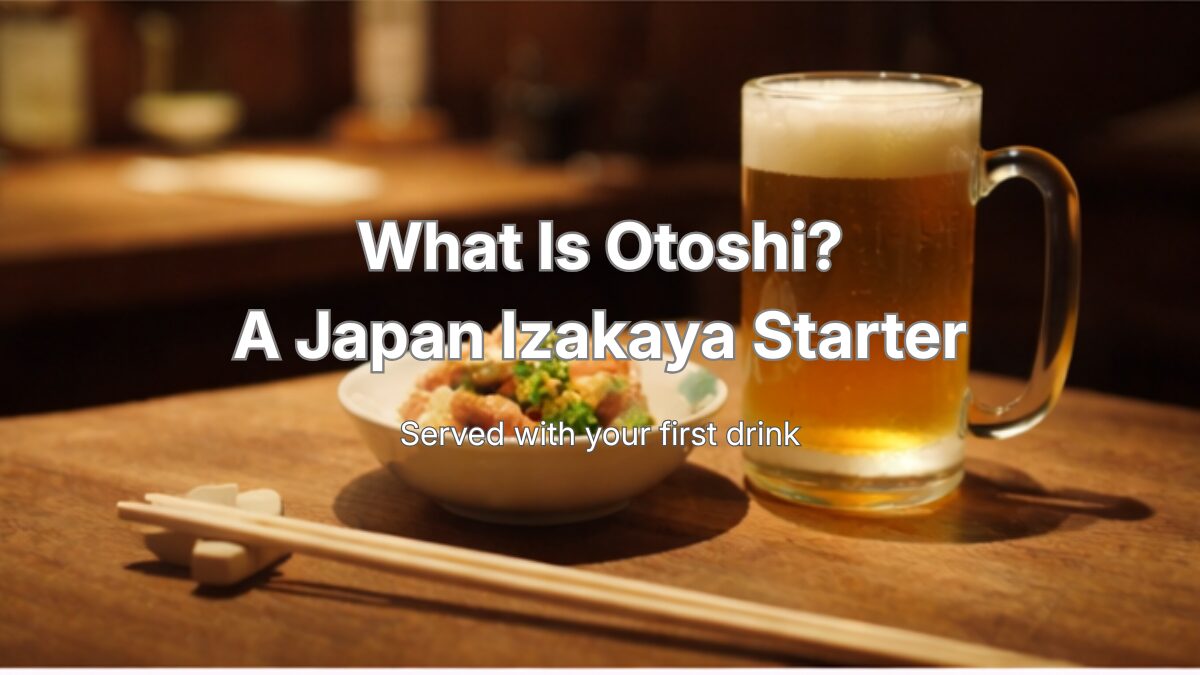
That small starter is often called otoshi.
If it’s your first time, it can feel uncomfortable—like something you never ordered, or an extra charge you didn’t expect.
But in Japan, otoshi is often treated as part of how an izakaya meal begins, especially in places where drinking is assumed.
This guide explains when otoshi usually appears (and why lunch feels different), how it connects to the first drink flow, and how many locals think about it.
Once you understand the structure, it becomes much easier to enjoy an izakaya without unnecessary suspicion or stress.
When you’ll see otoshi: it’s tied to drinking, not lunch
Otoshi usually appears in places where drinking is part of the experience—most commonly at izakaya in the evening.
Many izakaya assume you will start with a first drink, and in some restaurants otoshi arrives together with that first drink.
In contrast, otoshi is usually not part of lunch in Japan.
During the day, most restaurants operate as meal-focused places: you order food, you eat, and you leave.
Set-meal restaurants, ramen shops, cafes, and soup curry spots are typically food-first, and otoshi is rarely part of that style.
There are exceptions.
Some chain izakaya and casual pubs operate daytime “lunch drinking” hours.
In those cases, otoshi may still appear during the day if you order alcohol.
So it is often more accurate to connect otoshi to whether the place is operating as a drinking-focused venue, not simply the time of day.
Once you hold that assumption, the moment feels much less confusing.
How izakaya starts: drinks first, then food
At night, a common first question at an izakaya is:
“What would you like to drink?”
Many visitors expect to choose food first.
But at an izakaya, the order is often reversed.
You order the first drink, and you choose food while the drink is being prepared.
A typical flow looks like this:
- You sit down.
- You order the first drink.
- While the drink is being prepared, you choose food.
- The first drink arrives (and otoshi may appear at this moment).
- Then you order food and continue ordering as you go.
Even today, many izakaya use tablets or QR ordering, but the structure often remains the same:
drinks first, then food.
Once you understand that flow, otoshi feels less like “a dish that was pushed on you,” and more like a small signal that the first drink moment has started.
What otoshi is: a small snack and a bridge
Otoshi is a small dish served soon after you sit down.
The content varies by restaurant, but it is usually something simple and quick to serve—small side dishes, a light appetizer, or a small salad.
Most locals do not treat otoshi as “a dish they ordered.”
It is usually understood in two practical roles:
- A small snack with the first drink
- A bridge while you wait for food orders to begin
At many izakaya, people continue choosing dishes even after the first drink arrives.
So having a small bite on the table makes it easier to relax, sip the first drink, and look at the menu without feeling rushed.
From the restaurant’s side, it also helps “start the table” while orders settle.
Travelers often feel confused when they interpret otoshi as “an extra dish that was pushed on me.”
But in many izakaya, it is simply treated as the small opening snack that arrives at the start of the drinking flow.
Once you know that framing, the moment feels much more normal.
Why it’s often not “optional”
Even though otoshi arrives as food, many restaurants treat it as something that begins once you take a seat.
That is why asking to remove the charge after it has been served often does not work.
It helps to understand how many locals interpret it.
Most people in Japan do not think of otoshi as a dish you choose from the menu.
They often treat it as part of the “first drink set”—a built-in part of how izakaya service starts.
For some visitors, it may help to compare otoshi to tipping—not because it is the same, but because it can feel like a small extra cost that comes with the experience.
The difference is that tipping is optional, while otoshi is usually treated as part of the restaurant’s standard flow.
So when it appears, many customers simply eat it and move on.
They accept the cost as part of how the evening starts, and they don’t push further.
That said, not every restaurant works the same way.
If you ask before anything is served, some places may allow refusal.
And if you have a clear reason—such as allergies—it is often more realistic to ask whether it can be changed rather than insisting it be removed.
In short: otoshi is often treated less like “a dish” and more like “the start of service.”
That is why many places do not treat it as optional.
Quick notes to avoid misunderstanding
Otoshi often feels confusing because it can arrive without explanation.
For many locals, it is simply part of the normal izakaya flow, so some restaurants do not explain it in detail.
- Otoshi is usually not a scam. It is often treated as part of how izakaya service begins.
- It helps to think of it as a small snack with the first drink.
- Meal-focused lunch places usually don’t have otoshi. If it appears during the day, it is often connected to “lunch drinking” and ordering alcohol.
- Whether it’s optional depends on the restaurant. After it is served, changing the bill is often difficult.
If you want clarity, the simplest method is asking once at the start.
You don’t need a long explanation—just one short question:
- “Do you have otoshi?”
- “Is there a seating charge?”
Once you confirm the structure, the moment usually feels much easier.
Trivia: “izakaya,” “otoshi,” and “tsukidashi”
You may hear that the word izakaya is often explained as “staying at a sake shop.”
Historically, people normally bought alcohol at a shop and drank at home.
Over time, some shops began letting customers drink there, and the idea of “staying at the sake shop” became part of how people explained what an izakaya is.
The term otoshi is often linked to the verb meaning “to lead someone to a seat.”
In older styles of restaurants and izakaya, it was common to serve a quick, simple dish soon after seating—something small to bridge the wait while orders were being prepared.
That opening dish gradually became associated with the term otoshi.
In many parts of Japan—especially in Kansai—you may also hear the word tsukidashi used instead.
The wording differs, but the function is very similar: a small starter served at the beginning of the drinking flow.
