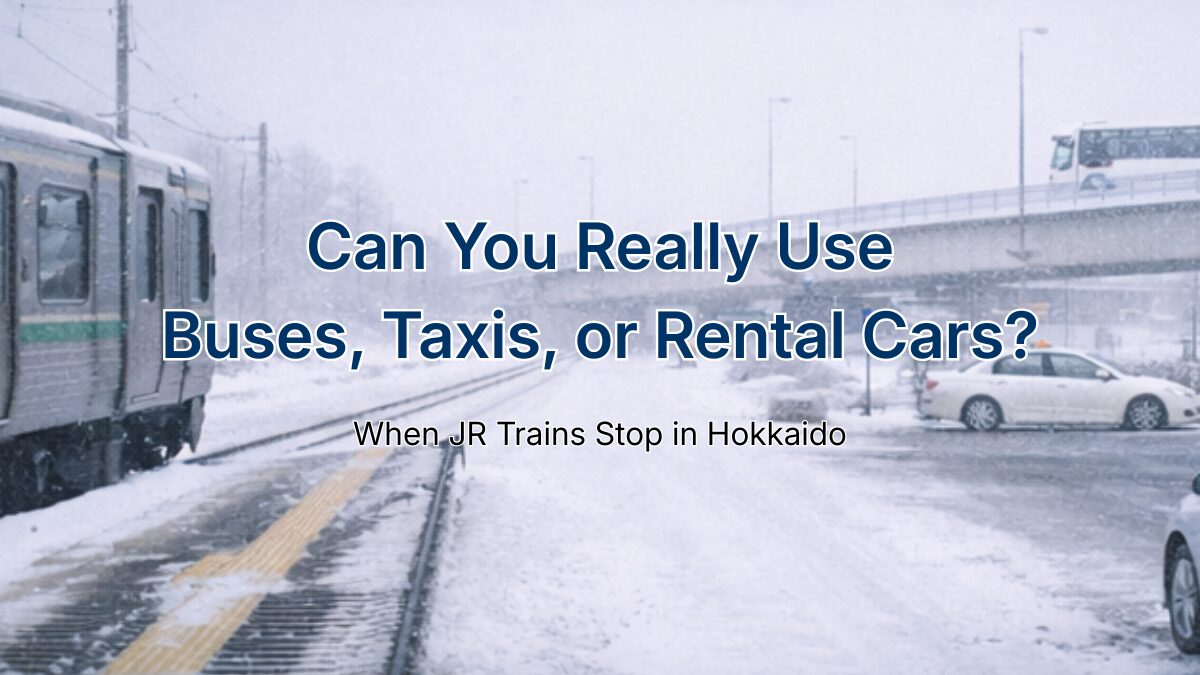
When JR trains stop, many travelers immediately think:
“Maybe buses are still running?”
“Can I just take a taxi?”
“What if I rent a car instead?”
Technically, those options exist.
There are timetables.
There are booking pages.
But in Hokkaido, when train services are suspended,
“available” does not always mean “usable.”
It is not only about heavy snow.
Strong winds, poor visibility, accidents, infrastructure checks,
and even wildlife collisions can also lead to suspensions.
And depending on the reason, the operating conditions for other transportation options change.
Each transportation mode has its own suspension criteria,
its own operating structure,
and its own way of assessing risk.
There are days when highway buses continue operating while JR services stop.
There are also days when highways close entirely.
Taxis may be on the road — but impossible to secure.
Rental cars may show availability — yet be unrealistic in practice.
This article does not compare which option is better.
Instead, it explains the structural conditions under which each alternative becomes realistic — or not.
Rather than assuming something “must be available,”
let’s look at whether it is actually usable.
What “Available” Really Means During a Snow Disruption in Hokkaido
You may see “operating” on a website.
You may see “available” on a booking page.
A taxi app may show cars nearby.
At first glance, that looks usable.
But in Hokkaido, when conditions are serious enough to suspend train services,
there can be a significant gap between “available” and “usable.”
A highway bus may be listed as scheduled —
yet be cancelled shortly before departure.
A taxi app may show cars on the map —
yet your request never gets accepted.
A rental car may show inventory —
yet you may not be able to realistically reach the rental office.
This is not exaggeration.
Operational decisions in Hokkaido often shift toward the safety side.
It is also important to understand that different transportation modes are governed by different decision-makers.
Railway operators, bus companies, road administrators,
taxi companies, and rental car agencies
all operate under different structures.
That means:
JR suspension does not automatically mean other options will run.
And it also does not automatically mean everything will stop.
The key question is not whether something exists —
but whether it is realistically functioning at that moment.
When Highway Buses Keep Running — and When They Don’t
There are days when JR services stop,
yet highway buses continue running.
This is not about buses being stronger.
It is about different suspension criteria.
JR prioritizes track safety.
If visibility drops,
if equipment checks are required,
or if a safety-first decision is made,
train services may be suspended.
Highway buses operate under a different condition:
whether the road is open.
If the highway remains open,
buses may continue running.
That is why you sometimes see trains stopped
while buses are still operating.
However, the reverse can also happen.
If a snowstorm intensifies,
if an accident occurs,
or if highways are officially closed,
buses will also stop.
Another important distinction:
“Operating” does not mean “you can get on.”
When JR suspends service,
passenger flow shifts rapidly toward bus routes.
Reservation-based routes sell out quickly.
Even non-reserved routes can develop long lines.
Highway buses sometimes run when trains do not.
But that does not automatically make them a reliable fallback.
Different structure.
Different outcomes.
Why Taxis Disappear Faster Than You Expect
“Maybe I can just take a taxi.”
That is often the first thought.
There are taxi stands near stations.
Ride-hailing apps are available.
But when JR services are suspended,
taxis disappear faster than most people expect.
The reason is simple:
Demand concentrates immediately.
When trains stop,
people near the station begin searching for alternatives at the same time.
Taxis become the most immediate option —
so requests surge within minutes.
In central urban areas,
vehicles can disappear very quickly.
An app may show cars nearby,
yet your request may never be accepted.
Weather and road conditions also influence driver decisions.
Some drivers may avoid long-distance trips
if return routes are uncertain.
“On the road” is not the same as “you can secure one.”
Taxis are indeed an option.
But they often become unstable in disruption situations.
Rental Cars: Technically Possible, Often Not Practical
“What about renting a car?”
This is another common alternative.
Rental cars do exist.
You may even see availability online.
However, whether they are realistic during a train suspension is a different question.
First, inventory can disappear quickly.
When trains stop,
many travelers think of the same solution at the same time.
Even if same-day booking is possible,
vehicles may be fully reserved within hours.
Second, you still need to reach the rental office.
If station areas are congested or conditions are unstable,
even getting there can take time.
The biggest factor, however, is driving conditions.
In Hokkaido, road and weather conditions can change quickly.
Strong winds, poor visibility, rain, or snow
can make driving more demanding than expected.
Even if highways remain open,
that does not automatically mean comfortable driving.
For travelers who are experienced in such conditions,
rental cars can sometimes work.
For many visitors, however,
they are often not the most realistic option in disruption scenarios.
Rental cars are not impossible.
They are simply not always rational.
When Doing Nothing Becomes the Most Rational Option
Just because alternatives exist
does not mean you must move immediately.
When JR suspends service,
other transportation options often become unstable as well.
A bus may be running.
A taxi may be available.
A rental car may appear bookable.
But each option comes with conditions.
Is there a seat?
Can you realistically secure it?
Is travel time predictable?
Will the next leg of your journey still function?
If these factors remain uncertain,
moving too early may simply shift the problem to another location.
In Hokkaido, conditions can change within hours.
Waiting does not guarantee recovery.
However, it can sometimes clarify which options are genuinely functioning.
“Moving” is not always the proactive choice.
In some situations,
not moving can be the more rational decision.
The key is not urgency —
but understanding structure before choosing.
Understanding Structure Before Choosing an Alternative
When JR suspends service,
alternative options do exist.
Highway buses.
Taxis.
Rental cars.
All of them are, in theory, choices.
What matters, however,
is that each operates under a different structure.
Different suspension criteria.
Different decision-makers.
Different operating conditions.
That is why there are days
when trains stop but buses continue running —
and other days when everything becomes unstable.
This is not about which option is stronger.
It is about whether an option is realistically functioning at that moment.
“Available” on a screen
does not automatically mean usable in practice.
In Hokkaido,
that gap can become significant.
Before choosing an alternative,
understand the structural differences.
Then decide whether it is realistic in that specific situation.
That perspective can help reduce unnecessary movement
and secondary disruption.
