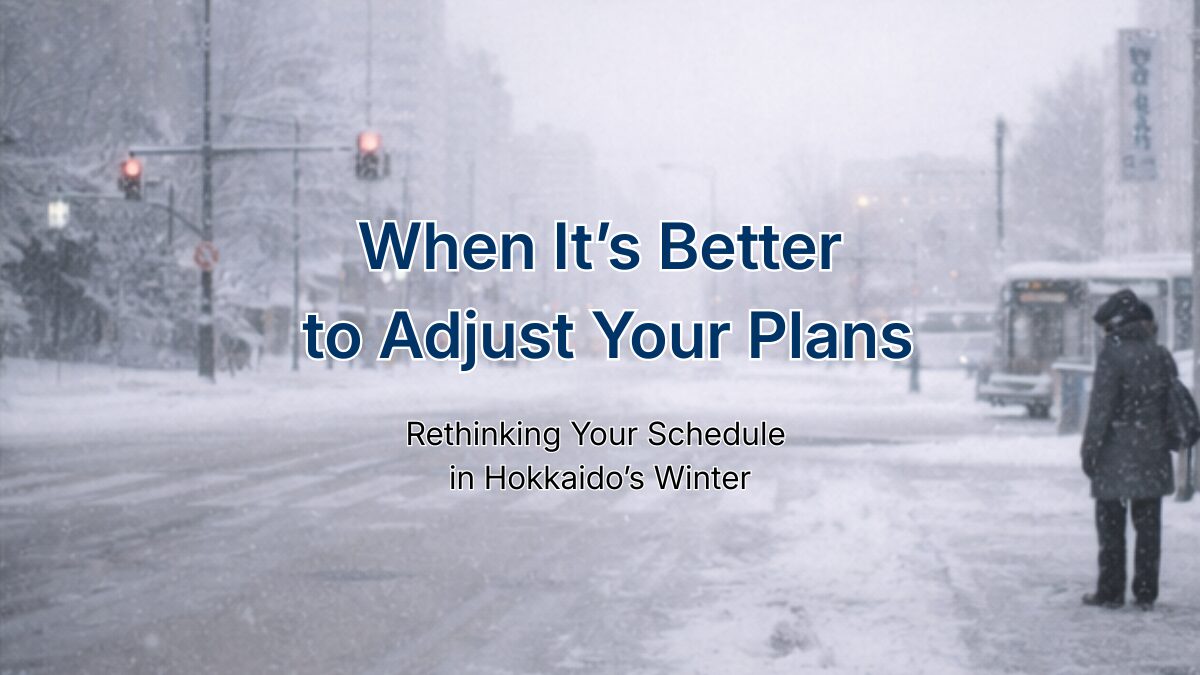
In Hokkaido’s winter, transportation rarely collapses all at once.
More often, it begins to unravel gradually.
First, a delayed train.
Then partial cancellations.
Then a notice saying, “Service suspended. Recovery time unknown.”
At that stage, most travelers try to protect their original schedule.
Hotels are already booked.
The next city is planned.
The return flight has a fixed date.
“Maybe it will run tomorrow.”
That is a very natural reaction.
Especially if this is your first time in Hokkaido.
Especially if you feel, “I came all this way.”
However, in Hokkaido’s winter,
the longer you delay a decision,
the fewer options remain.
This article is not meant to create fear.
And it is not suggesting that you abandon your trip at the first sign of snow.
Instead, it aims to clarify the moment
when holding onto your schedule becomes riskier than questioning it.
Sometimes, reducing your plans
is what protects the entire journey.
Why “Sticking to the Plan” Can Make Things Worse in Hokkaido’s Winter
When transportation begins to break down, most travelers first ask:
“Can I still follow the original schedule?”
That reaction is not wrong.
Winter travel in Hokkaido is usually carefully planned.
Hotels are booked in advance.
Travel days are limited.
Return flights are fixed.
After preparing that much, it feels natural to protect the plan.
However, the structure of your trip matters.
If you are traveling on an organized tour,
transportation may be arranged by bus,
and decisions may be made by the tour operator.
If you are traveling independently,
every decision — and every movement — depends on you.
This becomes especially important
if you are scheduled to change accommodation that day.
In some situations, moving before transportation fully stops
may be the only way to keep options available.
The real difficulty is not when transportation completely shuts down.
It is when it begins to wobble.
At that stage, movement may still be possible.
So you wait.
You think it might recover tomorrow.
And the decision is postponed.
While you wait,
cancellations can expand,
transport options can shrink,
and accommodation availability can decrease.
The feeling of “I came all this way” can quietly dull your ability to reconsider.
Protecting the schedule becomes the priority,
while protecting the entire trip moves into the background.
As a result, the more you try to preserve the original plan,
the fewer choices may remain.
In Hokkaido’s winter,
there can be a moment when the schedule itself becomes the risk.
Recognizing that shift early
often determines how much flexibility you still have.
Signs That It May Be Time to Question Your Schedule
Deciding whether to adjust your schedule
should not be based on emotion.
It should be based on observable conditions.
In Hokkaido’s winter, there are several signs to watch for.
First, when cancellations begin spreading outward.
If disruption is no longer limited to one section,
but begins affecting additional routes or time slots,
the situation may be expanding rather than stabilizing.
Second, when service notices continue to say “recovery time unknown.”
If no concrete restart time is announced and hours continue to pass,
it may indicate that operators do not yet have a clear outlook.
Weather warnings at an official alert level are another signal.
If forecasts show worsening conditions,
planning based on recovery becomes increasingly uncertain.
Another important indicator is local behavior.
If residents begin reducing movement,
if business hours are shortened,
or if events are canceled,
these are signs that “normal operations” are shifting.
When several of these conditions overlap,
it may be time to reconsider the assumption that your schedule will hold.
The key is not to wait until everything stops completely.
It is to evaluate your options
while movement is still possible.
Reducing plans early
often preserves more choices overall.
Doing Less Can Be the Smarter Choice
Reducing your plans may feel like losing something.
You may remove a destination you were looking forward to.
You may cancel a transfer to another city.
You may decide to stay in one place instead of moving.
From the perspective of your original itinerary,
these changes can feel like setbacks.
However, in Hokkaido’s winter,
doing less can sometimes protect more of the trip.
Shortening travel distance reduces exposure to disruption.
Canceling intercity movement reduces the number of points where problems can occur.
Staying in one area allows you to focus on decisions within a smaller scope.
The goal is not to preserve everything.
It is to clearly define what you can still protect.
For example:
“Not moving today.”
“Staying one more night.”
“Canceling a day trip.”
These choices may appear passive,
but they are often strategic.
Instead of chasing what you cannot control,
you narrow the range of what you need to control.
Doing less can be smarter.
In Hokkaido’s winter,
there are moments when a stable stay
is more valuable than a perfectly completed itinerary.
What Often Happens When You Wait Too Long to Decide
When transportation is unstable,
the biggest issue with delaying a decision is not “the worst-case scenario.”
More often, what happens is quieter:
small disadvantages accumulate,
and your ability to choose disappears.
For example, while you think,
“Let’s wait a little longer,”
another cancellation is announced.
While you wait for the next update,
available accommodation begins to shrink.
If you do not decide while movement is still possible,
you may later discover that the options you expected are no longer available.
This usually does not feel like a dramatic failure.
It appears as something more practical:
you are no longer choosing — you are accepting what remains.
Delaying a decision can also make the entire day feel unfinished.
You do not know whether you can depart.
But you also do not commit to staying.
You do not know whether to pack or not.
When this uncertainty continues,
it is often not your energy that breaks first — it is your decision-making.
And that leads to a harder situation:
making choices only after options have already narrowed.
In Hokkaido’s winter,
deciding earlier tends to preserve options.
Deciding later often means deciding after options have already disappeared.
The point is not that you must rush.
It is that the cost of waiting is real.
Reframing the Trip: Changing the Plan Without “Failing”
Changing your schedule often carries psychological resistance.
You created the plan.
If you cannot follow it,
it may feel like something went wrong.
However, in Hokkaido’s winter,
adjusting to conditions is part of travel skill.
The purpose of a trip is not to complete every item on a checklist.
Staying safe,
reducing unnecessary strain,
and returning smoothly
are also forms of success.
Reducing movement.
Limiting the number of cities.
Rearranging the itinerary.
These are not defeats.
They are responses to changing conditions.
Experience is not the same as schedule.
If skipping one destination protects the rest of the journey,
that is not failure.
In Hokkaido’s winter,
flexibility often stabilizes the entire trip.
Changing your plan is not abandoning your journey.
It is redesigning it to match reality.
Conclusion|When Reducing Plans Protects the Whole Trip
In Hokkaido’s winter,
following the original schedule is not always the highest priority.
When conditions begin to shift,
the important question is not whether you can protect the plan,
but whether you can question it.
“I came all this way.”
“Maybe it will run tomorrow.”
“I don’t want to undo what I carefully arranged.”
These reactions are natural.
However, the longer you delay a decision,
the fewer options remain.
Reducing your plans is not a defeat.
Shortening movement.
Limiting destinations.
Adding one more night in the same place.
These are not signs of giving up.
They are adjustments that protect the entire journey.
In Hokkaido’s winter,
there are moments when stability matters more than completion.
A flexible decision often preserves satisfaction better than a perfect itinerary.
Reducing your plans does not make the trip smaller.
It helps prevent the trip from breaking.
