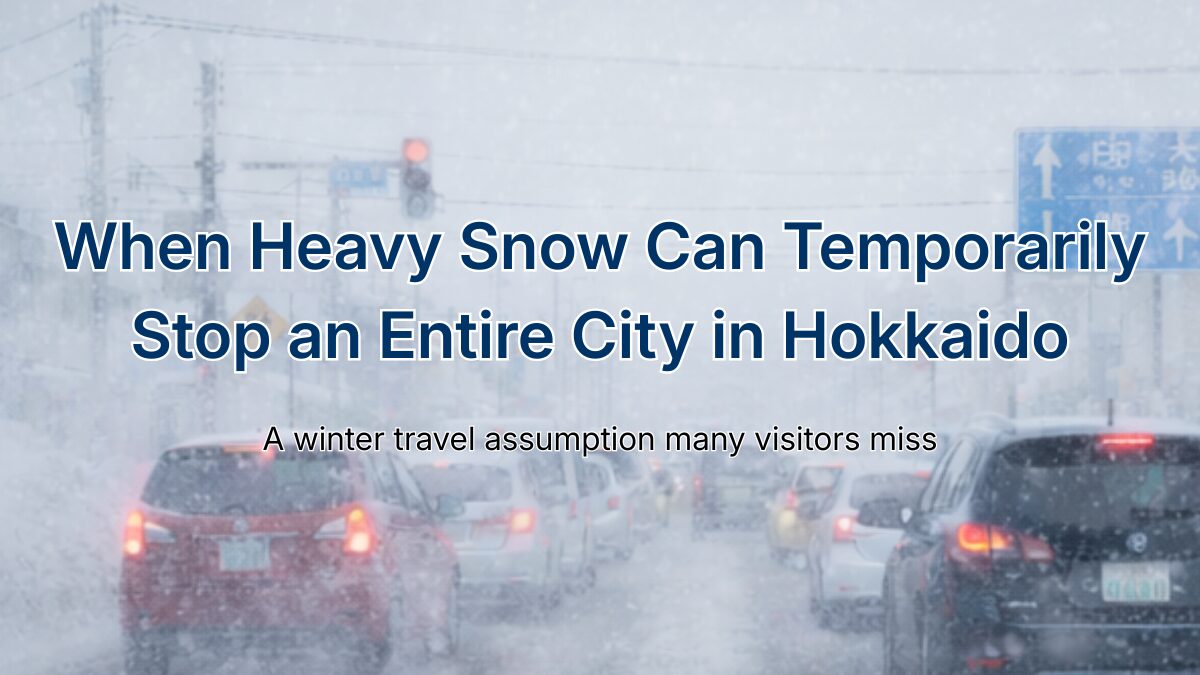
Winter travel in Hokkaido is often explained simply as “there is a lot of snow.”
That description is not wrong, but it does not fully capture the reality.
Once every few years, the main issue is not the amount of snow itself,
but the way heavy snowfall can temporarily slow down or stop city functions.
Transportation pauses.
Logistics are delayed.
Movement across the city does not follow schedules as planned.
This can happen even in major urban areas.
This does not occur every winter.
At the same time, it is not treated as a rare or abnormal event by people who live in Hokkaido.
From a local perspective, it is something that could happen at any time.
For travelers, the important point is this:
when plans stop moving as expected, that situation itself is not unusual here.
Without this assumption, later decisions about trains or airport access
can easily become misaligned with reality.
This article does not explain how to deal with JR delays,
airport access, or weather forecasts.
Those topics are covered in separate articles.
The purpose here is only to share one basic assumption:
in Hokkaido, there are winters when heavy snow can temporarily stop an entire city.
Heavy snow in Hokkaido is not just “a lot of snow”
Winter in Hokkaido is often described as something predictable.
Snow starts falling in December,
continues through January,
and peaks in February.
Until not so long ago, many winters roughly followed that pattern.
In recent years, that sense of consistency has clearly changed.
There are winters with very little snow around Christmas,
and some years even begin without the typical early accumulation.
At the same time, when snow does arrive,
it can fall all at once.
Not gradually, but suddenly—
similar to a localized downpour, only with snow.
This article does not rely on detailed climate data.
From the perspective of people living in Hokkaido,
one thing is simply clear:
the climate is no longer the same as it was several decades ago.
As a result, the real issue is often not the total amount of snow,
but the timing and concentration of snowfall.
When heavy snow arrives in this way,
transportation, logistics, and everyday movement across the city
can slow down all at once.
To understand winter in Hokkaido,
it is not enough to think of it as “a place with a lot of snow.”
Some winters bring snow in a way that directly affects city functions,
and that possibility needs to be part of the basic assumption.
There are winters when city functions temporarily slow down or stop
It is easy to assume that serious snow-related disruption only affects rural or mountainous areas.
In Hokkaido, that assumption does not always hold.
Even in major cities such as Sapporo,
certain patterns of snowfall can cause the entire city to slow down for a period of time.
When snow accumulates,
the usable width of roads effectively becomes narrower.
Lanes are reduced,
intersections move more slowly,
and traffic congestion becomes much more likely.
As a result,
roads become crowded,
public transportation schedules are disrupted,
and the movement of people and goods no longer follows the plan.
When these issues occur at the same time,
the city functions at a noticeably reduced level.
The key point is not whether everything stops completely.
Even partial slowdowns can trigger a chain reaction,
making the city as a whole stop working smoothly.
In Hokkaido, snow removal and winter preparedness are built into daily life.
Still, when heavy snowfall is concentrated into a short period of time,
even urban areas can temporarily exceed those assumptions.
For local residents, this may feel like a stretch of inconvenient days.
For visitors, however,
it can quickly become a situation where planned movement itself no longer works.
Assuming that a major city will always function normally,
simply because it is a city,
can lead to misunderstandings about winter travel in Hokkaido.
This does not happen every year, but it is not an abnormal event
After reading this far,
some people may feel that this sounds like an unusually extreme situation.
In reality, these conditions do not occur every winter.
They are often described as happening “once every few years,”
and that description is not incorrect.
What matters here, however,
is not to treat this as a rare or abnormal event.
For people living in Hokkaido,
it is understood as something that could happen again at some point.
This is separate from questions like
whether a winter is considered severe or mild,
or whether snowfall totals are high or low.
It is about the nature of winter itself,
and the fact that city functions can temporarily stop working smoothly.
Because of this,
judgments such as “this year should be fine”
or “it has not happened recently, so it is unlikely”
do not fit well with how winter is experienced here.
It does not happen every year.
But it is also not something outside expectations.
That balance reflects the reality of winter in Hokkaido.
For visitors, the impact is often bigger than expected
When city functions temporarily slow down,
it is inconvenient for local residents as well.
However, visitors are structurally more affected by these situations.
The reason is simple.
Travel plans are usually built on the assumption that things move on schedule.
Check-in times.
Opening hours of attractions.
Departure times for the next train or flight.
Connections between transportation.
All of these are linked together to form a travel itinerary.
When the movement of the city slows down,
these connections begin to break one by one.
A small delay leads to another delay,
and eventually parts of the plan no longer work.
Local residents still have a place to return to,
even if plans change.
Life continues despite the inconvenience.
For visitors, however,
being unable to move as planned on a single day
can affect the entire trip.
In addition, visitors often lack local knowledge.
Switching to alternative routes,
rearranging schedules,
or making quick adjustments can be difficult,
even when information is available.
In winter in Hokkaido,
the main issue is often not the snow itself,
but the fact that plans stop moving as expected.
And visitors are usually the ones most affected by that reality.
When plans stop moving, that itself is not unusual here
From the outside, winter delays in Hokkaido are often imagined as simple disruptions.
Snow falls, things slow down,
and once conditions improve, everything returns to normal.
In winters when city functions are affected,
the situation is different.
It is not just that things are delayed,
but that the assumption of moving according to schedule no longer holds.
Plans do not move as expected.
The length of the delay is unclear.
And the impact does not always end within a single day.
What happens today can easily affect tomorrow.
The important point is how this is understood.
Rather than seeing it as an unlucky or exceptional situation,
it makes more sense to recognize that Hokkaido winters include periods like this.
During travel,
people often try to recover lost time,
push forward,
or force the next step of the itinerary.
When the movement of the city itself has slowed down,
that approach does not always work.
In some cases, it leads to more confusion and frustration.
Simply having this assumption in mind
changes later decisions.
It makes it easier to pause and reassess
instead of reacting out of urgency.
This is not about fear or danger.
It is about understanding that in winter in Hokkaido,
being unable to move according to plan
is not, by itself, an abnormal situation.
Why this assumption matters before making any transport decisions
What has been described so far is not about snow being heavy or temperatures being low.
It is about one basic assumption:
in winter in Hokkaido, the movement of the city itself can slow down.
Without this assumption,
transport-related decisions are easy to misjudge.
Thoughts like
“it should start moving again soon”
or “it’s a main route, so it should be fine”
do not always apply when the overall pace of the city has dropped.
At this stage, the goal is not to decide on specific actions.
Whether to use JR,
how to reach the airport,
or how to interpret weather information
are topics addressed in later articles.
The key question here is simpler:
are you assuming that plans will move as scheduled,
or are you first looking at the current condition of the city?
That order matters.
Starting from schedules can lead to rushed or forced choices.
Starting from the city’s condition makes it easier to organize options calmly.
This article does not offer conclusions or instructions.
It only asks readers to keep one thing in mind:
in winter in Hokkaido,
understanding the state of the city comes before relying on the plan.
Summary|What to keep in mind before you rely on schedules in winter
Some winters in Hokkaido cannot be understood only as “a place with a lot of snow.”
In recent years, snowfall has felt less predictable.
There can be periods with little snow,
followed by sudden heavy snowfall that accumulates in a short time.
As a result, the main issue is often not the total amount of snow,
but the way the city itself can temporarily slow down.
Roads effectively become narrower, and congestion increases.
Transportation and logistics are disrupted,
and planned movement does not work as expected.
Even urban areas can experience this.
This does not happen every year.
At the same time, it is not something that can be separated as a rare or abnormal event.
For people living in Hokkaido,
it is understood as something that could happen at any time.
For visitors, the key assumption is simple:
being unable to move according to plan is not, by itself, an unusual situation here.
Keeping that in mind makes later decisions about JR and airport access
less likely to become misaligned.
