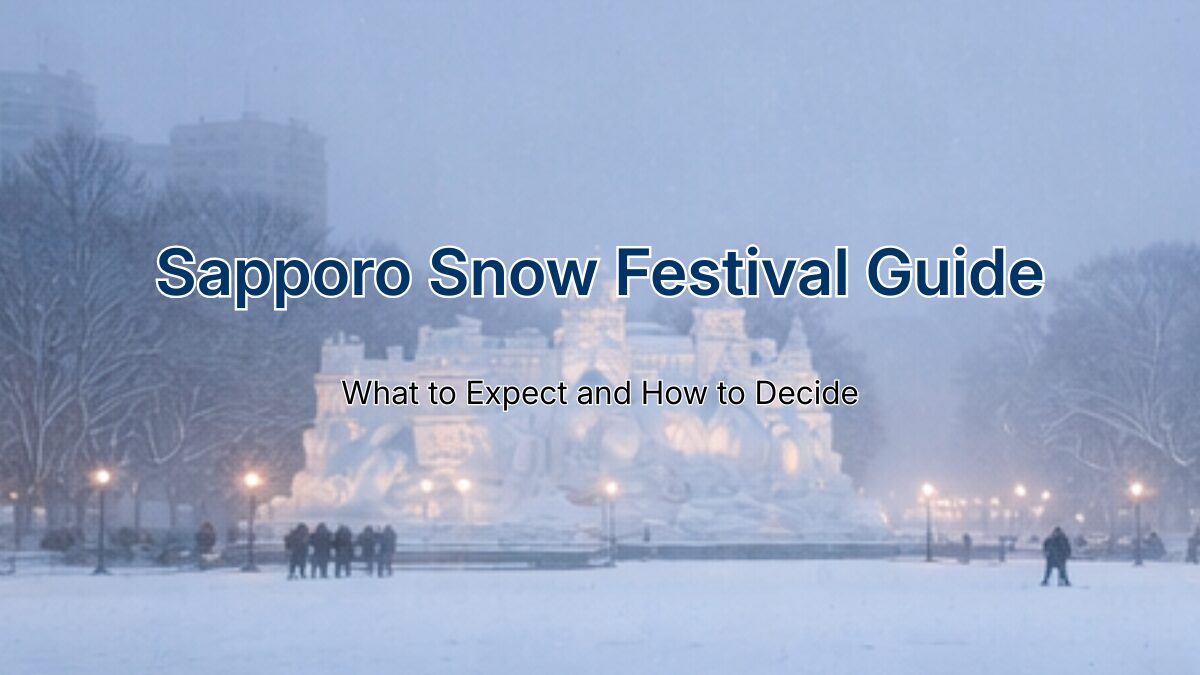
The Sapporo Snow Festival is widely known as one of Japan’s major winter events, especially among international travelers.
The massive snow sculptures, ice carvings, and nighttime illuminations look impressive in photos and videos, but many visitors find that the actual experience feels different from what they imagined.
That difference is easy to explain.
The festival is not just something you “look at.”
It comes with real conditions on the ground: extreme cold, icy sidewalks, large crowds, and longer walking distances than most people expect.
For those experiencing a Japanese winter for the first time, it is common to arrive without a clear idea of which venue to visit, how much time to spend, or how physically demanding the day can be.
Even repeat visitors or travelers who have been to Sapporo before often face new questions.
Is it worth visiting the same venues again?
Does the nighttime illumination really add value?
Is the festival manageable when traveling with family members, older travelers, or children?
In this article, I organize the Sapporo Snow Festival clearly for international visitors, based on my perspective as someone who lives in Sapporo.
I will break down the differences between the three venues, how much time you realistically need, when crowds become stressful, how slippery the streets actually are, and who the festival is more — or less — suitable for.
The goal is to help both first-time visitors and repeat travelers make choices that fit their own travel style and limits.
What the Sapporo Snow Festival Is — and Why People Visit
The Sapporo Snow Festival is a winter event held every February in Sapporo.
It began in 1950, when local students built a few snow sculptures in Odori Park, and has since grown into a large-scale festival that attracts visitors from both Japan and abroad.
What makes this festival unique is that it is not simply about “seeing snow.”
Visitors experience massive structures made entirely of snow and ice within the city itself.
Some of the large snow sculptures in the Odori area exceed ten meters in height, and most people find that their real scale and presence feel very different from photos or videos.
Another important aspect of the Sapporo Snow Festival is its temporary nature.
Before the official opening, visitors can sometimes see the sculptures being built, and during the festival, parts of the creation process are still visible in certain areas.
Once the festival ends, the sculptures are quickly dismantled and the city returns to its normal winter appearance.
For many people, this full cycle — being built, displayed, and then removed — is part of what makes the festival special.
At the same time, the Sapporo Snow Festival is not a theme park-style event.
There are no gates or fixed routes.
Instead, visitors walk through different parts of the city to see the sculptures spread across multiple venues.
For this reason, many people experience the festival less as a single attraction and more as a walk through Sapporo in winter, with snow and ice art along the way.
International visitors are drawn to the festival not only because of Japan’s snowy scenery, but also because these large-scale snow and ice sculptures appear in the middle of an urban area for only a short time.
At night, lighting and projection effects create a very different atmosphere from daytime, making the same locations feel completely transformed depending on when you visit.
However, the festival does not suit everyone equally.
Cold temperatures, long walking distances, and heavy crowds can be physically demanding, especially for those who are sensitive to cold, dislike crowds, or have limited mobility.
Rather than an event that is “fun for everyone,” the Sapporo Snow Festival is best understood as something to consider in relation to your own physical limits and travel schedule.
Understanding the Three Venues Before You Go
The Sapporo Snow Festival does not take place in a single location.
Instead, it is spread across three separate venues in different parts of the city: Odori, Susukino, and Tsudome.
Visitors who arrive without knowing this often find themselves surprised by how much moving and walking is involved.
The most important thing to understand is that each venue serves a different purpose.
Although they are all part of the same festival, the atmosphere, type of displays, typical length of stay, and the kind of visitors each venue suits can be very different.
Trying to approach all three with the same expectations often leads to unnecessary fatigue.
Odori is the main venue and the place most people associate with the image of the Sapporo Snow Festival.
This is where the large snow sculptures are displayed, and it most closely matches what first-time visitors expect based on photos and videos.
At the same time, the venue stretches over a long distance, and crowd density can be high, which means more walking than many people anticipate.
Susukino focuses on ice sculptures rather than snow.
The atmosphere is very different from Odori, with smaller-scale displays set within a busy nightlife district.
Seeing illuminated ice sculptures at night in the middle of the city can be memorable, but the area can feel crowded and hectic for those who prefer a quieter experience.
Tsudome is located outside the city center and is centered on hands-on snow activities rather than viewing sculptures.
Large snow slides and interactive attractions make it appealing for families and visitors who want to be physically active.
However, because reaching the venue takes additional time, it may be a lower priority for short stays or trips focused on sightseeing rather than activities.
What matters most is that visiting all three venues is not a requirement.
Deciding which venues fit your time, energy level, and travel style — and which ones to skip — makes a significant difference in how manageable and enjoyable the festival feels.
What to Expect at Odori Park (Main Snow Sculpture Area)
Odori Park is the largest venue of the Sapporo Snow Festival and the one that most closely matches what first-time visitors imagine when they think of the festival.
Snow sculptures are displayed along Odori Park, which runs east to west through the center of Sapporo and is divided into multiple sections.
One important thing to understand is how long this venue actually is.
Although it is called a single park, the Odori venue stretches across about ten city blocks.
That distance is easy to underestimate when looking at a map.
In summer, walking from one end to the other usually takes around 20 to 30 minutes.
During the Snow Festival, however, icy ground conditions and heavy foot traffic often slow everything down.
In winter, it can take nearly twice as long, and many visitors are surprised by how much energy the walk requires.
The main highlights of Odori Park are the large-scale snow sculptures.
Many are based on historical buildings or cultural themes, and their construction involves significant time and manpower.
Seen up close, the level of detail often feels far more impressive than what most people expect from photos alone.
At the same time, Odori Park is not always a calm place to view the sculptures.
Crowds tend to build from late afternoon into the evening, especially when people stop to take photos.
While the illuminated sculptures are visually striking, this is also when the venue becomes the most congested.
In addition to the massive snow sculptures, there are also many smaller works created by local groups, as well as character-themed displays.
These areas are sometimes easier to walk through and can feel more relaxed than the sections with the largest sculptures.
Rather than trying to see everything at once, Odori Park is best approached at your own pace.
Stopping where something catches your attention, turning back when you feel tired, or stepping underground to rest are all realistic options at this venue.
What Makes the Susukino Ice Sculpture Area Different
The Susukino venue feels very different from the rest of the Sapporo Snow Festival.
While Odori Park is a place where people go specifically to see snow sculptures, Susukino feels more like ice art placed directly into the middle of the city.
The works displayed here are made of ice rather than snow.
Many use highly transparent blocks of ice, allowing visitors to see details inside the sculptures during the daytime.
At night, lighting transforms the same pieces into something completely different, making time of day a key part of the experience at this venue.
That said, Susukino is not a quiet or calm environment.
It is located in Sapporo’s main entertainment district, with constant foot traffic, bright signs, restaurants, and passing vehicles.
For visitors who want to concentrate quietly on viewing or photographing sculptures, the surrounding activity can feel distracting.
Susukino works best for travelers who want to combine the festival with dinner or a night out.
It is easy to visit after walking through Odori Park, having a meal, and then stopping by to see the ice sculptures along the street.
For visitors who prefer to finish sightseeing during the daytime, the area may feel rushed or overly busy.
The scale of the displays here is smaller than at Odori Park.
Rather than a place to spend a long time, Susukino is better thought of as a venue to enjoy briefly and move on.
Instead of a location that everyone needs to visit, the Susukino venue makes the most sense when it fits naturally into your evening plans.
When the Tsudome Venue Makes Sense (and When It Doesn’t)
The Tsudome venue has a clearly different character from the other Snow Festival locations.
While Odori and Susukino focus mainly on viewing snow and ice sculptures, Tsudome is designed for physically experiencing snow through hands-on activities.
The main attractions here are large snow slides and activity-based experiences such as snow rafting.
Rather than simply walking and looking, visitors spend time waiting their turn, playing in the snow, and staying outdoors in cold conditions.
For this reason, Tsudome works well not only for families with children, but also for adults and couples who want to actively enjoy snow.
However, Tsudome is located outside central Sapporo.
From areas such as Odori Park or Sapporo Station, it is realistic to expect a one-way travel time of about 30 minutes to an hour using a combination of subway travel, walking, or shuttle buses.
A round trip alone requires time and physical energy, which can feel heavy during a short stay.
Waiting times are another factor.
On weekends or during busy periods, some activities require numbered tickets, and registration may close by the afternoon.
Because of this, Tsudome does not work well as a place to casually stop by for a short visit.
Even so, for visitors coming from countries or regions without snow, Tsudome can be well worth the effort.
You do not need to ski or snowboard to enjoy it.
Simply touching, sliding on, and playing in real snow is an experience that often becomes a memorable part of a trip to Japan.
The massive snow slides, in particular, tend to be enjoyable regardless of age.
Proper cold-weather preparation is essential.
Many activities involve sitting or sliding directly on snow, and it is common for people to feel extremely cold or end up with wet clothing, especially around the lower body.
Ski wear is ideal, but even wearing waterproof pants or simple rain pants — which can be purchased cheaply at local stores — makes a noticeable difference in comfort.
Tsudome should not be treated as a mandatory part of the Snow Festival.
It is best approached as a venue to choose based on whether you want to experience snow itself, and whether it fits your travel goals, companions, and available time.
How Much Time You Actually Need for the Festival
Many travelers wonder whether the Sapporo Snow Festival can be done in half a day, requires a full day, or takes multiple days.
In reality, the amount of time you need varies greatly from person to person.
It depends not only on which venues you choose, but also on how you handle cold temperatures, crowds, and the weather on the day you visit.
Even if you focus only on Odori Park, it is not a venue that can always be covered quickly.
If you simply walk through and take a few photos, you might finish in one to two hours.
However, because the distance is long and people often stop to look more closely, it is common to spend two to three hours or more without realizing how much time has passed.
Crowded periods slow everything down even further.
If you plan to visit both Odori Park and the Susukino area, setting aside about half a day usually provides enough flexibility.
Although the two areas are within walking distance, moving on snowy and icy streets adds to fatigue.
When visiting in the late afternoon or evening for illuminated displays, tolerance for cold often determines how long people stay.
Including the Tsudome venue generally means planning for a full day.
Travel time to and from the site, waiting times for activities, and time spent playing in the snow naturally add up.
Trying to combine Tsudome with other venues on the same day can feel physically demanding for many visitors.
Weather is another factor that is easy to underestimate.
During the festival, conditions are not always clear and calm.
Some days bring steady snowfall, while others can suddenly turn into strong snowstorms that reduce visibility and make being outdoors uncomfortable.
On days like this, simply moving around takes more time and effort.
Because of this, the same plan can require very different amounts of time depending on the weather.
It is wise to build flexibility into your schedule rather than expecting everything to go exactly as planned.
At a minimum, checking the weather forecast on the day of your visit helps you decide how much time to spend outside and whether adjustments are needed.
The Sapporo Snow Festival involves a lot of walking and time spent outdoors.
Approaching it with the mindset that “seeing some of it is enough” often leads to a more comfortable and satisfying experience than trying to see everything.
Crowds, Timing, and When It Gets Stressful
Many visitors who feel that the Sapporo Snow Festival was more tiring than expected are affected less by the sculptures themselves and more by crowd conditions.
The experience can change significantly depending on which venue you visit and, more importantly, at what time of day.
The busiest period is typically from late afternoon into the evening.
As people finish work or sightseeing, crowds increase at the same time that the illuminated displays begin.
At Odori Park in particular, frequent stops for photos can slow movement to a crawl.
Daytime tends to be easier to walk through, but weekends and holidays are an exception.
Even during the day, crowds can be heavy, making it difficult to stop comfortably or move at your own pace.
Visitors who assume that daytime automatically means fewer people often feel a gap between expectations and reality.
Crowds become stressful not only because of the number of people, but also because of the conditions.
Standing still in cold temperatures, moving slowly, and carefully watching your footing on icy ground all add to physical and mental fatigue.
In slippery areas, simply walking requires more attention and energy.
Another point to be aware of during crowded periods is the risk of children becoming separated.
Japan is generally a safe country, but in dense crowds, it is easy for a child to slip out of sight in a moment.
At events like the Snow Festival, where foot traffic frequently stops and starts, children getting lost is not unusual.
Looking at individual venues, Odori Park shows the greatest difference depending on time of day.
A route that feels manageable in the early afternoon can take twice as long in the evening.
Because Susukino is primarily an evening destination, it is best approached with the assumption that crowds will always be present.
For visitors who dislike crowds or are traveling with small children, aiming for weekday mornings through early afternoon can make a noticeable difference.
You do not need to see every sculpture.
Sticking to areas with lighter foot traffic is often enough to enjoy the overall atmosphere.
At the Snow Festival, the most visually impressive moments often coincide with the busiest times.
Deciding in advance how much crowd density you are comfortable with, and how closely to stay with children, makes it easier to enjoy the event without pushing beyond your limits.
How to Move Between Venues Without Getting Exhausted
At the Sapporo Snow Festival, many people end up using more energy on moving between venues than on actually viewing the sculptures.
For first-time visitors to Sapporo in winter, it is important to understand that movement itself is rarely a form of rest.
To begin with, no transportation option between venues is consistently easy.
Odori and Susukino are close enough to walk between, but snowy and icy ground conditions combined with heavy foot traffic often make the walk more tiring than expected.
Using the subway does not automatically mean less fatigue.
While it is warmer underground, reaching the platforms involves stairs, long passages, ticket gates, and crowded flows of people.
In practice, many visitors find themselves thinking that walking above ground would have been easier.
Sapporo’s underground pedestrian passages can be helpful, but they are best seen as places to temporarily avoid cold temperatures and slippery streets rather than as a complete transportation solution.
They do not connect every destination, and trying to rely on them exclusively can sometimes result in longer detours.
Traveling to the Tsudome venue requires either a combination of subway travel and walking or the use of shuttle buses.
During the Snow Festival period, guidance is available, but movement can still take longer during busy times.
Allowing extra time helps prevent arriving already exhausted.
The key to conserving energy is not committing to a single transportation method.
Adjusting your choice based on weather, crowd levels, and how tired you feel — walking at one moment, going underground at another, or deciding not to move further at all — makes a significant difference.
Winter in Sapporo can be draining even when standing still.
Taking short breaks indoors to warm up during movement can slow the buildup of fatigue.
Treating movement as a chance to recover, rather than something to endure, makes the overall experience much more manageable.
When moving between venues, prioritizing comfort over efficiency often leads to a better experience.
At the Snow Festival, choosing the least demanding option at the moment is usually the right call.
Walking on Ice: Slipping Risks and the Reality of Winter Roads
One of the first things many visitors struggle with at the Sapporo Snow Festival is the condition of the ground.
Not only are there areas covered in snow, but many paths are packed down and frozen solid, making them far more slippery than they appear.
The most dangerous spots are often places that look completely normal.
Areas where little snow remains and black asphalt is visible can actually be coated with a thin layer of ice.
Many people slip precisely because they think, “This looks fine.”
Winter roads in Hokkaido are often much more slippery than they look.
Because of this, it is important not to walk the same way you normally would.
Taking shorter steps and placing your entire foot gently on the ground makes a noticeable difference.
Sudden stops or quick changes in direction increase the risk of slipping and are best avoided.
A helpful way to picture the movement is to walk like a penguin.
Instead of lifting your feet fully off the ground as you normally would, keep them low and move them forward in small, flat steps.
If you watch how local residents walk in winter, you will notice that they naturally keep their center of gravity low and avoid sharp, unstable movements.
Footwear should also be viewed realistically.
Even shoes labeled as “non-slip” cannot completely prevent falls on icy surfaces.
In Sapporo, you may see people using simple traction devices that attach over regular shoes.
These are mainly used by visitors or people who are not accustomed to winter roads, rather than by locals in their daily routines.
During the Snow Festival period, they are sometimes available at nearby convenience stores or temporary shops.
What often causes fatigue is not falling itself, but repeatedly almost slipping.
Constantly tensing your body to avoid a fall puts strain on your legs and lower back.
This ongoing tension is one reason many visitors feel more exhausted than expected.
Crowded areas require extra caution.
When you are forced to move with the flow of people, it becomes harder to focus on your footing, increasing the risk of slipping.
Even people who live in Sapporo slip during winter.
While it is impossible to eliminate the risk entirely, walking without assuming that you will never fall helps reduce unnecessary strain and risky movements.
At the Snow Festival, walking safely matters more than walking quickly.
Paying attention to your footing and allowing yourself to stop and rest when needed can make a significant difference in how tiring the day feels.
What to Wear: Staying Warm Without Overpacking
When preparing clothes for the Sapporo Snow Festival, many visitors assume that wearing as many layers as possible is the safest choice.
In reality, over-layering can make the experience more uncomfortable than expected.
During the festival, you spend long periods outdoors but also move in and out of warm places such as underground malls, shops, and subway stations.
If you dress too heavily, it is easy to sweat indoors, which can make you feel colder once you step back outside.
The most practical approach is clothing that allows adjustment through layering.
Instead of relying on a single extremely warm item, it is easier to manage comfort by wearing lighter layers that can be added or removed as needed.
Leaving room to adjust — adding a layer when cold and removing one when warm — makes a big difference.
For your upper body, a wind-resistant outer jacket alone can greatly affect how cold you feel.
Rather than focusing only on thick insulation, choosing an outer layer that blocks wind helps maintain comfort both while walking and when standing still.
One especially important point is keeping your neck warm.
Simply covering your neck with a scarf or neck warmer can significantly improve how warm you feel overall.
Many people find that protecting the neck is more effective than adding extra layers to the torso.
If you watch how people in Sapporo dress in winter, you will notice that many wear the hood of their jacket or coat up.
Just pulling up the hood helps block wind and reduces heat loss around the ears and the back of the neck.
Even without a hat, using a hood alone can noticeably change how cold the weather feels.
The lower body is another area that is often underestimated.
Because the festival involves long periods of walking and standing outdoors, thin pants alone can feel cold quickly.
Adding a pair of tights or a light thermal layer underneath can make a clear difference in comfort.
Gloves are also easy to overlook.
Cold hands make it harder to take photos or use a smartphone comfortably.
Even relatively thin gloves that block wind help reduce this stress.
The goal is not to eliminate the cold completely, but to stay comfortable while moving and while standing still.
Clothing choices depend on the weather, crowd levels, and how active you plan to be.
Checking the weather forecast and choosing clothes that allow easy adjustment — especially around the neck and with a hood — helps keep the experience manageable.
Using Food, Warm Breaks, and Indoor Spaces to Recover from the Cold
At the Sapporo Snow Festival, how well you manage recovery often matters more than how much you try to see.
Spending long hours outdoors in cold conditions gradually drains energy, even if you do not notice it right away.
One important point is the timing of warm food and drinks.
While food stalls and restaurants can be attractions on their own, taking time to warm your body from the inside makes a clear difference.
Even a hot soup or drink can help you recover more than expected.
That said, drinking warm beverages often leads to needing a restroom sooner than expected.
This is a natural reaction when your body warms up in cold weather.
During the Snow Festival, however, restrooms around the venues tend to be crowded.
Especially during busy periods or in the evening, waiting times can be long.
For this reason, it is wise to use the restroom as soon as you enter an indoor space, rather than waiting until it becomes urgent.
Moving a bit earlier helps avoid unnecessary stress.
If you wait until you are completely exhausted before going indoors, you may feel relief at first but then lose the motivation to move again.
Entering a warm space before reaching that point makes it easier to recover without losing momentum.
Central Sapporo has many restaurants, cafés, and underground areas, making it relatively easy to find places to warm up.
Simply deciding in advance where you might stop can make walking outside feel less demanding.
When it comes to meals, lighter options are often more practical.
Heavier meals can make it harder to move afterward and affect the rest of your schedule.
Warm but moderate food helps stabilize your body temperature without slowing you down.
Using underground passages or large indoor facilities as part of your route is also effective.
Rather than treating them as sightseeing spots, they can function as recovery points while moving toward your next destination.
Because time outdoors tends to be long at the Snow Festival, consciously increasing how often you go indoors — and thinking ahead about restroom timing — can greatly change how tiring the day feels.
Instead of pushing yourself with the thought that you can handle a little more, stepping inside earlier often leads to a more relaxed and enjoyable experience overall.
Getting There from New Chitose Airport
New Chitose Airport looks relatively close to central Sapporo on a map.
However, during the Snow Festival period, how the trip feels depends heavily on weather, crowd levels, and time of day.
If you plan with the assumption that everything will run “normally,” your schedule can become tight very quickly.
The most practical baseline option is the JR Rapid Airport train.
It is frequent, straightforward, and generally the least confusing choice for first-time visitors.
The ride to Sapporo Station is roughly around 40 minutes, which makes this route the default for most travelers.
At the same time, crowding is common during the Snow Festival season.
In the evening or on weekends, airport passengers and tourists overlap, and you may need to ride standing.
If you are carrying large luggage, the physical load increases quickly, even before you reach the festival venues.
Weather is another factor that cannot be ignored.
Heavy snowfall or strong snowstorms can cause delays or service disruption.
This does not happen every day, but it is risky to build a schedule that depends on everything running perfectly the moment your flight lands.
In many cases, it is more realistic to go to your hotel first, drop your luggage, and then head out.
Walking on snowy streets and moving through crowded festival areas while carrying heavy bags can drain energy faster than most visitors expect.
It is also worth noting that conditions at the airport can feel different from central Sapporo.
Even if you feel fine while moving around the airport, the city can feel colder or windier than expected.
Having a bit of time to adjust clothing, use restrooms, and settle in helps reduce stress.
If you want to visit the festival on your arrival day, it often works best to treat it as a short “first look” rather than an attempt to cover everything.
Experiencing the cold and crowd conditions in person and adjusting your plan afterward usually leads to a more manageable trip.
New Chitose Airport is indeed well connected to Sapporo, but during the Snow Festival period, travel itself becomes part of the experience.
Building in extra time and energy margin often determines how enjoyable the rest of the festival feels.
Where to Stay During the Festival (and Where Not To)
During the Sapporo Snow Festival, where you stay has a major impact on how tiring or comfortable your days feel.
Choosing a hotel based only on price or availability can lead to unexpected fatigue from cold weather and repeated travel.
One of the most straightforward options is staying near Odori Park.
Being close to the main venue makes it easy to visit both during the day and at night.
However, hotels in this area tend to be expensive and fill up quickly.
This location works well if proximity matters most to you, but the cost and crowd levels are important trade-offs to consider.
Sapporo Station is another very practical area.
It offers direct access from New Chitose Airport and has extensive underground walkways, restaurants, and shops.
Reaching the Odori venue from this area is simple by subway or on foot, making it a reliable choice, especially for first-time visitors.
The Susukino area is also popular, particularly for travelers interested in nightlife and evening activities.
It is convenient for visiting the ice sculpture areas at night and for dining out.
On the other hand, the lively atmosphere can feel less restful for those who prefer quieter surroundings.
Some travelers choose locations farther from the center along subway lines.
These areas often offer lower prices and better availability, but they come with longer travel times.
During the Snow Festival, this means additional exposure to cold and more physical effort, especially late at night or in poor weather.
Choosing a hotel simply because it is cheaper or easier to book can backfire if daily travel becomes exhausting.
A realistic decision considers not only price, but also distance, cold conditions, and crowd levels.
Another important factor is whether you can stay multiple nights in the same hotel.
Changing hotels during the festival adds the burden of moving luggage on snowy streets.
Staying in one place for several nights is usually far easier on your body and schedule.
When selecting accommodation, it helps to think beyond how close it is to the venues.
Choosing a place you can comfortably return to at the end of the day often leads to a better overall experience.
Is the Sapporo Snow Festival Worth It for You?
The Sapporo Snow Festival is well known and highly photogenic, but it is not an event that everyone must visit.
Whether it feels worthwhile depends greatly on your preferences, physical condition, and travel goals.
The festival tends to suit people who can tolerate cold weather and long periods of outdoor activity.
The snow and ice sculptures are impressive, but seeing them requires spending extended time outside.
If cold temperatures themselves are a major source of stress, the experience may feel less enjoyable than expected.
For visitors from countries or regions without snow, the festival can feel less like an exhibition and more like an environmental experience.
Even without skiing or snowboarding, walking on snowy streets and spending time in a winter city can be memorable on its own.
Crowd tolerance is another important factor.
From late afternoon into the evening, crowds increase significantly, making it harder to move at your own pace.
If dense crowds are uncomfortable for you, limiting your visit to daytime hours, keeping it short, or choosing not to go at all are reasonable options.
Physical effort should also be considered realistically.
Walking on frozen or snowy surfaces places more strain on your legs and lower back than normal walking.
Assuming it will be an easy sightseeing activity can lead to unexpected fatigue.
That said, the burden decreases if you do not try to see everything.
Visiting only the Odori venue, leaving before crowds peak, or stepping indoors when the cold becomes too much can still make the experience feel complete.
What matters most is not whether the festival is famous or popular, but whether it fits your travel style and physical condition.
The Sapporo Snow Festival is not something you must attend for a successful trip.
At the same time, if the conditions are right for you, it can become a winter memory that is difficult to experience elsewhere.
Rather than treating it as a mandatory attraction, it works best as one option among many.
I hope you are able to enjoy the Sapporo Snow Festival in a way that suits you best.
