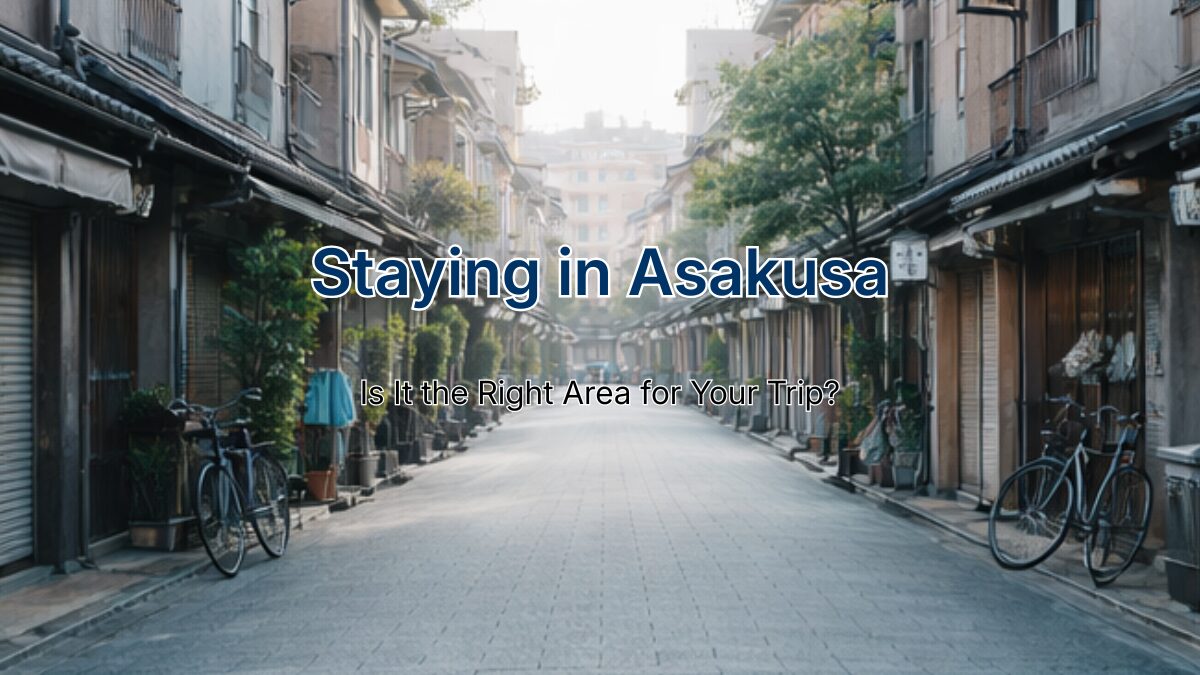
Asakusa is often very appealing to first-time visitors to Tokyo.
With its temples and traditional downtown atmosphere, it’s widely known as a place where you can feel a strong sense of “old Tokyo.”
At the same time, many travelers hesitate.
They wonder whether staying in Asakusa is actually convenient, and whether it works well as a base for exploring Tokyo.
Questions about airport access and overall transportation convenience are especially common.
Famous sightseeing areas can sometimes feel different in practice than they do in images or guidebooks.
The actual experience of staying there—and how easy it is to move around—doesn’t always match expectations.
This article doesn’t judge Asakusa as simply good or bad.
Instead, it looks at airport access, daily transportation, and the overall stay experience to help clarify who Asakusa works best for, and who it may not.
If you’re drawn to Asakusa but unsure whether it’s the right choice,
the goal here is to help you decide calmly whether it fits your travel style.
Why Asakusa Attracts First-Time Visitors
One reason Asakusa often becomes a top option for first-time visitors is that it feels easy to imagine.
It represents a “traditional Japan” image more clearly than many other parts of Tokyo.
Asakusa has well-known sights like Senso-ji Temple and Nakamise Street in a compact area.
Because these places are widely shown in photos and videos, many travelers already have a clear picture of what they want to see.
Asakusa is also close to Tokyo Skytree, and many people plan Tokyo sightseeing with that combination in mind.
Having a major, easy-to-recognize landmark nearby can feel reassuring when it’s your first trip.
Another reason is that the sightseeing area feels relatively walkable.
For travelers who don’t want to move long distances every day, this can sound like a comfortable plan.
In the evening, the area often becomes calmer compared with places like Shinjuku or Shibuya.
This calmer atmosphere can also make Asakusa feel like an easier base for a first stay.
Because of these factors, Asakusa is often seen as a place that feels familiar, manageable, and comfortable for a first-time trip.
What Staying in Asakusa Is Actually Like
When you actually stay in Asakusa, the atmosphere changes noticeably between daytime and evening.
During the day, the area around Senso-ji Temple and Nakamise Street can be quite busy with visitors.
In the evening, however, the pace slows down.
Compared with major nightlife areas, Asakusa often feels calmer than many people expect.
Some travelers imagine that staying in a sightseeing area means constant noise.
In Asakusa, late-night activity is usually limited to certain streets, and many parts of the neighborhood become quiet after sunset.
Another feature of Asakusa is that it is both a tourist area and a lived-in neighborhood.
Just a short walk away from the main streets, you’ll find residential areas and a more local atmosphere.
Because of this, staying in Asakusa often feels like a mix of being close to major sights and experiencing a calmer, everyday side of Tokyo.
Whether this balance feels comfortable or inconvenient depends largely on your personal travel style.
Transportation from Asakusa and Airport Access
If you use Asakusa as your base, one important thing to understand is that major JR lines do not run directly through the area.
Most travel relies on subways and private railways, so using an IC card is the standard approach.
For getting around Tokyo itself, Asakusa offers access to several lines.
Reaching most parts of the city is not difficult, but trips to places like Shinjuku, Shibuya, or the Tokyo Station area often involve at least one transfer.
If minimizing transfers is a top priority for you, this may feel slightly inconvenient.
Airport access also depends on which line you use.
From Narita Airport, the Keisei Line provides relatively smooth access to the Asakusa area.
For Haneda Airport, direct access is possible depending on the train.
Some services run through to the Keikyu Line, allowing you to reach the airport without changing trains.
That said, not all trains offer through service, so checking your route in advance is a good idea.
Asakusa is also close to the Tokyo Skytree area around Oshiage.
You can move between the two easily on foot or with a short train ride.
However, being close to the Skytree does not automatically make Asakusa a convenient hub for traveling all over Tokyo.
Asakusa’s transportation is not exactly “bad,” but it does have its own quirks.
If your daily travel range is limited, or if atmosphere matters more than speed, these quirks are often manageable.
On the other hand, if you plan to move to different parts of the city every day,
it’s worth checking actual routes and transfer counts in advance to avoid surprises.
Who Asakusa Works Well For (and Who It Doesn’t)
Based on what we’ve covered so far, Asakusa is an area where suitability is quite clear.
It tends to work very well for some travelers, and less so for others.
Asakusa is a good fit for travelers who value atmosphere and a relaxed pace over transportation efficiency.
Many sightseeing spots are close together, making it possible to enjoy the area without moving long distances every day.
It also suits people who prefer quiet evenings.
If busy nightlife areas feel overwhelming, Asakusa’s calmer nights can be a comfortable change.
On the other hand, Asakusa may feel inconvenient for travelers who plan to move quickly between many different parts of Tokyo.
If your itinerary includes frequent trips to places like Shinjuku, Shibuya, or Roppongi, transfers and travel time can start to feel tiring.
Travelers who imagine staying “in the very center of Tokyo” may also find Asakusa slightly out of the way.
It doesn’t offer the same level of all-direction convenience as major transportation hubs.
Asakusa is not a one-size-fits-all choice.
But if its pace and atmosphere match what you’re looking for, it can become a very satisfying base for your Tokyo trip.
Asakusa vs Other Popular Areas
One helpful way to decide whether Asakusa fits your trip is to compare it with other well-known areas.
Looking at what feels different makes the choice clearer.
Compared with Shinjuku, Asakusa is much calmer.
Shinjuku’s biggest strength is transportation efficiency, but its huge stations and constant crowds can feel overwhelming.
If ease of movement is your top priority, Shinjuku often works better.
If you prefer a quieter base, Asakusa may feel more comfortable.
Ueno shares some similarities with Asakusa in terms of atmosphere.
However, Ueno has stronger access to JR lines, which can make airport access and city travel feel simpler.
On the other hand, Asakusa tends to feel more clearly like a sightseeing area.
Compared with Shibuya, the difference is most noticeable at night.
Shibuya stays lively late into the evening, while Asakusa becomes much calmer after dark.
If you enjoy energy and nightlife, Shibuya may suit you better.
If rest and quiet evenings matter more, Asakusa often feels easier.
Asakusa is not an area that excels at everything.
Instead, it offers a specific balance of atmosphere and pace.
Rather than asking which area is “better,”
it’s more helpful to compare what you want to prioritize during your trip.
Asakusa Can Be a Great Base—If It Fits Your Style
Staying in Asakusa is not a matter of being right or wrong.
What matters is whether Asakusa’s characteristics match your travel style.
Asakusa is not an area that prioritizes maximum transportation efficiency.
Instead, it offers clear sightseeing appeal, calmer evenings, and an atmosphere where you can experience a more traditional side of Tokyo.
One notable advantage is the morning atmosphere.
Senso-ji Temple and Nakamise Street are relatively quiet in the early morning, especially compared with the rest of the day.
If you stay within walking distance, you can enjoy these spots before crowds arrive, when the area feels calm and local.
Airport access and city transportation are manageable with some planning.
However, if your trip involves moving to different parts of Tokyo every day, transfers and travel time may start to feel noticeable.
Asakusa tends to work best for travelers who:
– want to explore at a slower pace
– enjoy quiet mornings and evenings
– value atmosphere as much as convenience
In the end, the question is not which area is the most convenient.
It’s about deciding what kind of time you want to have during your stay.
Using that perspective makes choosing a base in Tokyo much easier—and helps avoid regret later.
